




































Gala Casino — Platform Structure and System Logic
Gala Casino should not be read as a collection of games or offers. It functions as a structured platform where different layers operate simultaneously, each with its own logic and constraints. Understanding those layers is more useful than focusing on any individual feature, because the user experience is shaped by how these components interact over time rather than by isolated actions.
At the surface level, the platform presents familiar elements: slots, live games, bonuses, account tools, and payment options. These elements are visible, accessible, and easy to interpret. However, they do not define the system. They sit on top of a deeper structure that governs how access is granted, how sessions evolve, and how user behavior is monitored.
That structure can be separated into three distinct layers.
The first layer is the operational environment. This includes account creation, identity verification, deposit and withdrawal systems, session controls, and responsible gambling tools. It is the layer that determines how a user enters the system and how they are allowed to interact with it over time. It can introduce friction, limits, or restrictions depending on user behavior, but it does not influence the mathematical outcome of any game.
The second layer is the game ecosystem. This is where slots, table games, and live casino products exist. Each game operates under its own predefined mathematical model, including RTP and volatility. These parameters define how outcomes are distributed over a long horizon, not how a short session will behave. The system does not adjust these values based on user activity, account status, or previous results.
The third layer is the rule layer, which includes bonuses, wagering requirements, promotional conditions, and eligibility rules. This layer modifies how funds can be used or withdrawn, but it does not change the probability of outcomes within the game itself. Bonuses can extend play, restrict withdrawals, or define conditions, but they do not improve or reduce the likelihood of winning.
This separation is essential because many misunderstandings come from treating the platform as a single adaptive system. In reality, it is a set of independent systems that interact but do not override each other’s core logic.

UK Market Positioning
Operating within a UK context requires a different standard of clarity and control. The platform is expected to be transparent in how it presents rules, consistent in how it applies them, and structured in how it monitors user behavior. This creates an environment where marketing language is secondary to system clarity.
Instead of promising outcomes, the platform defines conditions. Instead of encouraging extended play, it provides tools to manage it. Instead of presenting bonuses as advantages, it frames them as optional structures with defined rules.
This approach aligns with regulatory expectations and creates a more stable user experience. It reduces ambiguity and limits the space for incorrect assumptions about how the system behaves.
Session Reality vs System Design
A user session often feels immediate and reactive. Wins and losses appear to follow patterns, especially in short sequences. However, this perception is not aligned with how the system is designed.
Game outcomes are generated independently. There is no memory between spins, no adjustment based on previous results, and no compensation mechanism that responds to user experience. What changes during a session is not the game, but the user’s interpretation of it.
The platform does not attempt to correct that perception through messaging. Instead, it provides structure:
- clear display of rules
- visible limits and controls
- access to history and transactions
- defined conditions for bonuses and withdrawals
These elements do not change outcomes, but they help the user understand the environment they are operating in.
Product Over Promotion
Gala Casino, when read correctly, is not built around persuasion. It is built around access and control. The platform provides a set of tools, a library of games, and a structured environment in which they operate.
The value of the platform is not in what it promises, but in how clearly it defines its rules and how consistently it applies them. That is what allows a user to navigate it without relying on assumptions or external narratives.
A well-structured platform does not need to over-explain itself. It needs to remain consistent.
Games Architecture and Mathematical Structure
The games layer inside Gala Casino is often treated as the “product” itself, but in reality it is closer to an execution environment. Each title operates as a self-contained system with its own parameters, rules, and statistical model. The platform does not reshape those mechanics dynamically. It provides access to them.
This distinction becomes important when trying to interpret how games behave over time. A slot, for example, is not a narrative experience that evolves in response to a player. It is a sequence of independent events generated under a fixed model. That model defines how often outcomes occur, how large they can be, and how they are distributed across a very large number of spins.
RTP is often the most visible number, but it is also the most misunderstood. It is not a short-term indicator and does not describe what a user should expect from a single session. It represents a theoretical return calculated across millions of events. In a short session, variance dominates. That means outcomes can deviate significantly from that model without contradicting it.
Volatility adds another dimension. It does not describe value or advantage. It describes distribution. A higher-volatility structure may produce longer sequences without notable events, followed by occasional larger movements. A lower-volatility structure tends to produce more frequent but smaller changes. Neither structure is inherently better. They define different pacing and different psychological experiences.
RNG operates beneath both of these parameters. It ensures that each event is independent. There is no accumulation, no correction, and no pattern memory. A sequence of losses does not increase the probability of a win, and a sequence of wins does not reduce it. This is not a design choice that can be adjusted by the platform. It is a foundational property of certified game engines.
Interpreting Game Categories
Different categories within the platform reflect different implementations of these same principles rather than fundamentally different systems. Slots, table games, and live dealer environments all operate under structured rules, but they vary in how outcomes are presented and how quickly events occur.
Slots are typically the most variance-driven category. They compress outcome distribution into rapid sequences, which increases the visibility of volatility. Table games, particularly those with fixed rules like blackjack or roulette, present outcomes in a more discrete format. Live casino environments add a human interface, but the underlying logic remains defined by the rules of the game rather than by platform behavior.
The important point is that category does not change independence. It changes pacing, presentation, and user perception.
Game Structure Overview
| Category | Mechanic | Volatility Profile | Pacing | RTP Range |
|---|---|---|---|---|
| Slots | RNG Driven | Variable | Fast | 94%–97% |
| Table Games | Rule-Based | Low–Medium | Moderate | 95%–99% |
| Live Casino | Real-Time | Medium | Slower | 94%–98% |
Practical Interpretation
The table is not a comparison of advantage. It is a structural overview. It shows how different categories behave in terms of pacing and distribution, not which category is “better.”
From a user perspective, the only controllable variable across all categories is exposure. Stake size, session length, and frequency of play define how the mathematical model is experienced. The model itself remains unchanged.
This is why platform design focuses on control mechanisms rather than outcome messaging. The system cannot improve probabilities, but it can influence how a user interacts with them.
Understanding that boundary is what allows the games layer to be read correctly — not as a system that responds, but as a system that executes.

Bonuses as Rule Layer, Not Outcome Layer
Bonuses inside Gala Casino are often interpreted as value enhancers, but in structural terms they function as conditional systems applied to the wallet layer. They do not interact with the mathematical core of any game. They do not increase probability, they do not stabilize outcomes, and they do not create favorable conditions within the RNG environment. What they do is modify how funds can be used, how they are released, and under what conditions they become withdrawable.
This distinction matters because it changes how bonuses should be evaluated. A bonus is not a shortcut to results. It is a framework that introduces rules. Those rules define eligibility, wagering requirements, game restrictions, and withdrawal conditions. Accepting a bonus means accepting those rules. Declining a bonus means operating without them. The underlying game remains unchanged in both cases.
Wagering is often described in simplified terms, but it is better understood as a release condition. It measures the volume of eligible bets placed before bonus-linked funds can be converted into withdrawable balance. It is not a task to complete, and it does not influence outcomes. It is a threshold that must be met within defined parameters.
The key point is that bonuses extend interaction with the system. They do not improve it.
Bonus Mechanics in Practice
Different bonus types apply different rule sets, but they all operate within the same structural logic. Some are designed to introduce new users to the platform, others to extend existing sessions, and others to provide periodic incentives. In every case, the bonus exists outside the game logic and inside the operational layer.
The effect is cumulative rather than transformative. A bonus may increase the number of interactions a user has with the system, but it does not change what happens within each interaction.
Bonus System Overview
| Bonus Type | Function | Wagering Intensity | Restrictions | Layer |
|---|---|---|---|---|
| Welcome Bonus | Initial deposit match | High | Game weighting, time limits | Rule Layer |
| Free Spins | Game-specific play extension | Medium | Restricted slots, capped winnings | Rule Layer |
| Cashback Bonus | Partial loss offset | Low–Medium | Minimum activity thresholds | Rule Layer |
| VIP Rewards | Loyalty-based incentives | Variable | Tier conditions, eligibility rules | Rule Layer |
Payments, Control Systems, and Responsible Structure
The final layer of Gala Casino is where the platform becomes most visible as a system rather than a product. Payments, verification, limits, and responsible gambling tools define how a user moves through the environment over time. This layer does not attract attention in the same way as games or bonuses, but it is the most important for long-term interaction.
Every transaction inside the platform is part of a controlled flow. Deposits are processed through predefined methods, withdrawals are subject to verification and timing rules, and account activity is continuously monitored against internal thresholds. These processes are not arbitrary. They exist to ensure that financial movement is traceable, compliant, and aligned with regulatory expectations.
Verification is often perceived as friction, but in operational terms it is a necessary condition for access. Identity checks, document validation, and account confirmation are part of how the system maintains integrity. Without them, withdrawals cannot be reliably processed, and user protection mechanisms cannot function correctly.
From a user perspective, this creates a structured environment where access is conditional but predictable. The rules are defined in advance. The system applies them consistently.
Control Mechanisms and User Interaction
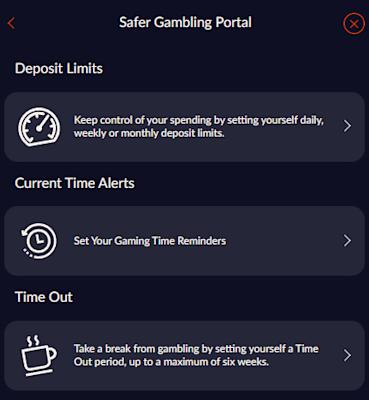
Control within the platform is not limited to system intervention. Users are given tools that allow them to define their own boundaries. Deposit limits, session reminders, and self-exclusion options are not reactive features. They are proactive controls that exist independently of behavior triggers.
This creates two parallel systems of control:
- user-defined limits, which can be set at any time
- system-triggered interventions, which activate when patterns indicate risk
These systems do not replace each other. They operate together. A user may never trigger an intervention but still rely on personal limits. Another user may bypass personal limits but still be subject to system controls if behavior escalates.
The important point is that control exists before, during, and after play. It is not tied to outcomes.
Operational System Overview
| System Element | Function | Control Level | Type |
|---|---|---|---|
| Payments Processing | Handles deposits and withdrawals | High | Operational |
| Account Verification | Ensures identity and compliance | Critical | Operational |
| Deposit Limits | User-defined spending control | High | User Control |
| Session Controls | Time and activity monitoring | Medium | User Control |
| Risk Monitoring System | Detects behavioral escalation | High | Operational |
Structural Interpretation
This table is not a feature list. It is a map of how the platform maintains control and consistency. Each element exists for a specific reason, and each operates within a defined layer.
Payments ensure that financial flow is controlled. Verification ensures that access is legitimate. Limits ensure that users can define boundaries. Monitoring ensures that those boundaries are not exceeded without detection.
None of these elements affect the outcome of a game. They affect the conditions under which the game is accessed.
This is the final distinction that defines the platform. Gala Casino is not a system that changes outcomes. It is a system that controls access to them.
Understanding that difference removes most of the ambiguity around how the platform behaves.


















Comments